Tri-Planar NeRFs enable the application of powerful 2D vision models for 3D tasks, by representing 3D objects using 2D planar structures.
This has made them the prevailing choice to model large collections of 3D objects.
However, training Tri-Planes to model such large collections is computationally intensive and remains largely inefficient.
This is because the current approaches independently train one Tri-Plane per object, hence overlooking structural similarities in large classes of objects.
In response to this issue, we introduce Fused-Planes, a novel object representation that improves the resource efficiency of Tri-Planes when reconstructing object classes, all while retaining the same planar structure.
Our approach explicitly captures structural similarities across objects through a latent space and a set of globally shared base planes.
Each individual Fused-Planes is then represented as a decomposition over these base planes, augmented with object-specific features.
Fused-Planes showcase state-of-the-art efficiency among planar representations, demonstrating \(7.2 \times\) faster training and \(3.2 \times\) lower memory footprint than Tri-Planes while maintaining rendering quality.
An ultra-lightweight variant further cuts per-object memory usage by \(1875 \times\) with minimal quality loss.
Method
Method overview.
A set of Fused-Planes \(\{T_i\}\) reconstructs a class of 3D objects \(\{O_i\}\) from their GT views \(\{x_{i,j}\}\), where \(i\) and \(j\) respectively denote the object and the view indices.
For clarity, only one Fused-Planes is shown.
(a) Each Fused-Planes \(T_i\) is formed from a micro plane \(T_i^\mathrm{mic}\) which captures object-specific information, and a macro plane \(T_i^\mathrm{mac}\) computed via a weighted summation over a set of shared base planes \(\mathcal{B}\).
This base captures class-level information like structural similarities across objects.
(b) View synthesis is performed in the latent space of an auto-encoder (\(E_\phi\), \(D_\psi\)) via classical volume rendering. The rendered latent image \(\tilde{z}_{i,j}\) (low resolution) is decoded to obtain the output RGB view (high resolution).
(c) The Fused-Planes components (i.e. \(T_i^\mathrm{mic}\), \(\mathcal{B}\), \(W_i\)) and the autoencoder are supervised with three reconstructive losses.
Results
Resource Costs
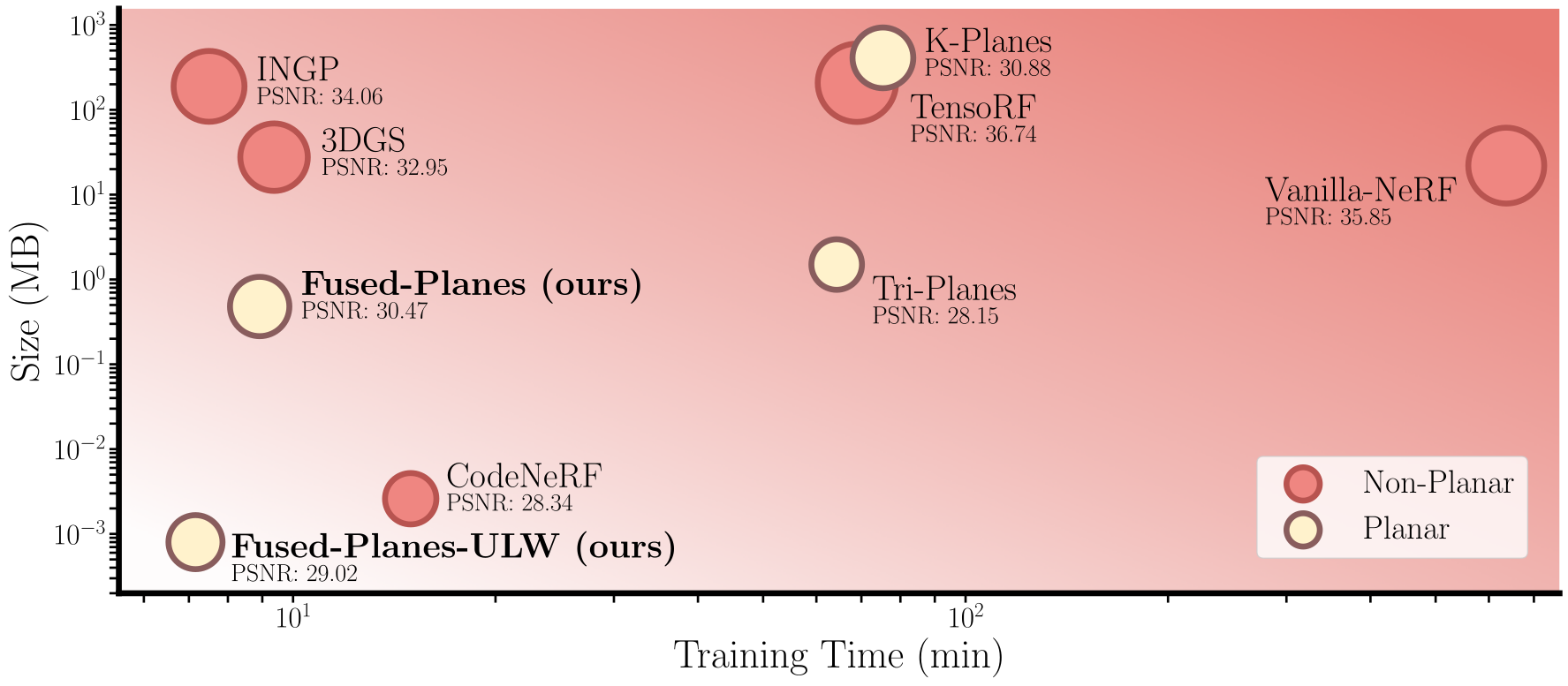
Resource costs overview.
To reconstruct a large class of objects, one would consider three options: many per-scene models (e.g. INGP, 3DGS, or planar methods), a multi-scene method (e.g. CodeNeRF), or Fused-Planes.
Our method presents the lowest per-object training time and memory footprint among all planar representations, while maintaining a similar rendering quality.
Circle sizes represent the NVS quality.
Comparison with classical Tri-Planes
Shapenet Cars Scenes
Fused-Planes
Tri-Planes
Basel Faces Scenes
Fused-Planes
Tri-Planes
Analysis of base planes
Visualization of rendered base planes
We provide below videos showing the learned base planes for the cars and faces datasets.
Protocol for base planes visualisations. Recall that, in our standard pipeline, we render a learned Fused-Planes-ULW representation \(T_i\) (corresponding to scene \(i\)) using volume rendering followed by a decoder.
Each fused representation is defined as:
\(T_i = \sum_{k=1}^{M} w_i^{k} B_k . \) (a)
For the visualizations shown below, we do not render \(T_i\). Instead, we directly render individual base planes \(B_k\).
Note: In the ULW model, each \(B_k\) has the same dimensionality as \(T_i\), which makes such visualizations possible.
Using this protocol, we visualize the 10 different base planes below.
Observations: These visualizations show that base planes can be grouped into two categories:
Semantic: some base planes clearly encode object-level structures (e.g., faces, cars),
Residual: other base planes capture finer intra-class variability relative to the semantic base planes.
Together, these base planes contribute to each object representation.
Base planes weights values for two objects
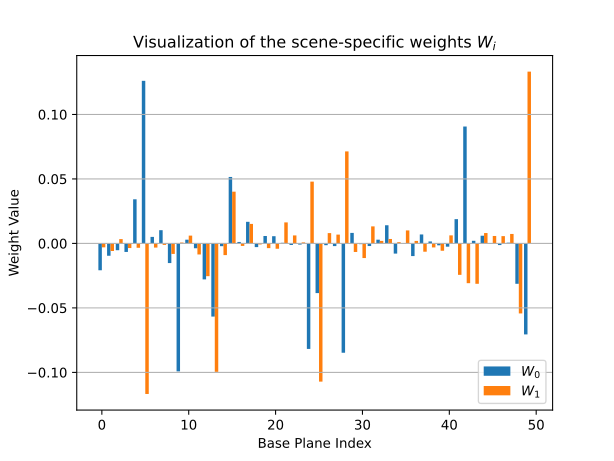
We further visualize the values of the learned weights \(W_i\) used to compose each Fused-Planes representation using eq. (a), in the figure below:
The weights above correspond to the following two cars:
Observations: We observe that a few base planes dominate the final fused representation, and the dominant planes vary across scenes, while other base planes contribute only minor adjustments.
Note: These visualizations are done using the Fused-Planes-ULW (ultra-lightweight) variant of our method, which trades-off some rendering quality for significant efficiency gains.
Interpolating between two weights
We visualize below the Fused-Planes-ULW resulting from a weight interpolation.
Specifically, we first choose two weights \(W_1\) and \(W_2\) corresponding to two scenes.
We then compute \(W_t = t * W_1 + (1-t) * W_2\) for \( t \in \{0, 0.25, 0.5, 0.75, 1\}\).
Injecting \(W_t\) into eq. (a) yields a set of Fused-Planes-ULW visualized below.
Observations: Interpolations between weights yield coherent scenes, where we transition smoothly from one scene to another (e.g. the mouth closes gradually across the different faces).
BibTeX
      @inproceedings{fused-planes,
        title={{Fused-Planes: Why Train a Thousand Tri-Planes When You Can Share?}},
        author={Karim Kassab and Antoine Schnepf and Jean-Yves Franceschi and Laurent Caraffa and Flavian Vasile and Jeremie Mary and Andrew Comport and Valérie Gouet-Brunet},
        booktitle={The Fourteenth International Conference on Learning Representations},
        year={2026},
        url={https://openreview.net/forum?id=bAG7lS1AUL}
      }